

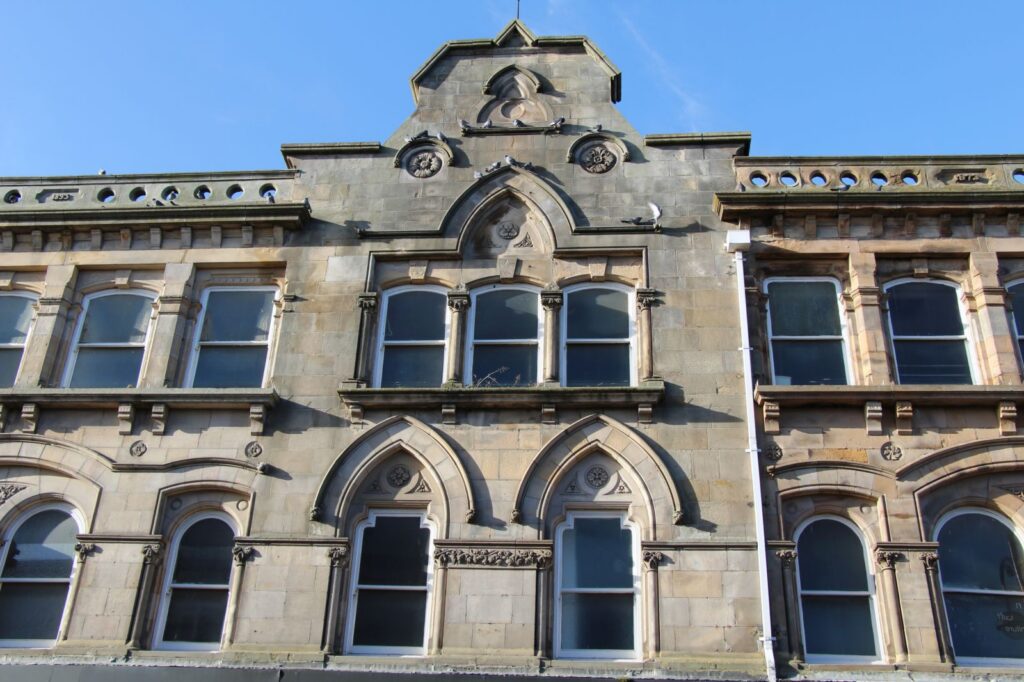
The old Co-op building on Newgate Street, later known as Beales, is one of the most important buildings in Bishop Auckland. For many local people, it is more than an empty shop. It is part of the town’s story. It reminds us of a time when ordinary working people came together to build something for themselves, their families, and their community.
Today, the building is closed and in poor condition. But it was once a busy and proud centre of trade, jobs, services, and local life. Its story is also the story of Bishop Auckland, Shildon, Coundon, Spennymoor, Ferryhill, Evenwood, Hunwick, and the wider south Durham coalfield.
How it began
The Bishop Auckland Cooperative Society was founded on 25 February 1860. A group of working men met in a schoolroom in Shildon. They wanted to buy food and goods together, sell them at fair prices, and share the profits with members. Their aim was simple: fair dealing, honest weights, and a better deal for ordinary people
The idea quickly caught on. Within two months, 118 people had joined. On 28 May 1860, the society opened its first small shop in South Church Lane, Bishop Auckland. It may have been a modest shop, but it gave local people something powerful: a business they owned together.
By September 1861, the society had bought a shop and house on Newgate Street for £720. This put the Co-op at the heart of Bishop Auckland’s growing town centre. It also prepared the way for the large building that would later become such a well-known landmark.
A building full of pride
In the 1870s, the society grew fast. In 1873, it asked architect William Vickers Thompson to design a new headquarters on Newgate Street. The new three-storey building opened on New Year’s Day 1874 with a procession, a brass band, and a tea for 700 people. Newspapers at the time called it one of the finest buildings in the town.
Inside, the building was carefully planned. The ground floor had large shopping areas. Offices and committee rooms were upstairs. Storage space was placed on the higher floors. The design showed confidence, openness, and civic pride.
The society kept expanding. A fire in 1876 damaged part of the warehouse area, but the Co-op rebuilt quickly. By the late 1800s, it had branches across south Durham, including Spennymoor, Tudhoe Grange, Ferryhill Station, Evenwood, Dean Bank, Chilton, Byers Green, Close House, and Hunwick. Membership grew to more than 16,000.
More than just shops
The Bishop Auckland Co-op was not only a shop. It became a major local organisation. It ran a bakery and slaughterhouse to supply bread and meat to members. It also opened a tobacco factory on Durham Street in 1898. That factory produced £280 worth of tobacco each week and made yearly profits of £1,800.
The society also built homes. It built 150 houses for rent, and many still stand today. Street names such as Kellett, Raine, Hutchinson, May, Owen, Holyoake, Neale, and Blandford remember people linked to the cooperative movement.
This matters because the Co-op helped shape daily life across the area. It provided goods, jobs, homes, services, and a sense that local people could improve their own lives by working together.
Coundon and the coalfield communities
The Co-op also grew in Coundon. As mining expanded, the population grew and people needed more shops and services. In 1890, the society bought land from Sir William Eden for £1,500. A large new store opened there on 24 April 1903. The Northern Echo described it as “large and commodious” and said it was the biggest building in the village.
This showed how important the Co-op had become to coalfield communities. It was part of everyday life for working families across the constituency.
What survives inside
Historic England has looked closely at the Newgate Street building. Its investigation found that the front part worked like a Victorian department store, with counters, display cases, high ceilings, decorative plasterwork, and fine joinery. Behind it were warehouses, offices, hoists, and loading bays.
The building changed over time, especially between 1873 and 1902. New departments, staircases, offices, and storage areas were added. Even though the building is now in poor condition, important parts of the original interior still survive. This makes it one of the most important old cooperative buildings in the region.
From Co-op to Beales
The building stayed in cooperative ownership until 2011, when it was sold to the department store chain Beales. Beales closed its Bishop Auckland branch in 2017. The company later collapsed in 2020. Since then, the building has stood empty.
Many people still call it “the Co-op” or “Beales”. Both names matter, because they reflect different parts of the building’s history.
The situation now
As of 2026, the building is still privately owned, but the owner has not been publicly named. There are no active planning applications, no redevelopment work is taking place, and no public plans have been announced. The building is Grade II listed, complex, and costly to repair. These are some of the reasons why progress has stalled.
At the same time, Newgate Street is now a major focus for regeneration. Problems with nearby buildings have delayed the STACK development, and Durham County Council has considered enforcement action over unsafe structures. The old Beales building has not been named directly, but growing concern about Newgate Street means it is likely to face more attention.
Why it matters
The old Co-op / Beales building is not just a problem to be solved. It is a reminder of what Bishop Auckland and the surrounding communities once achieved. It was built by people who believed in fairness, shared ownership, and local pride.
Its current condition is sad to see. But it is also an opportunity. If the building can be saved and given a new use, Bishop Auckland would not only protect an important part of its past. It would also send a message about the town’s future.
The building once stood for ambition, cooperation, and community strength. With the right plan, it could do so again.
80 Newgate Street, Bishop Auckland – 1292114 | Historic England